Android TV Is Quietly Winning the Microbusiness Signage Market
Cheap Android TV sticks turn any screen into signage. We break down real vendor pricing, the missing security audit, and the recurring bill behind “free.”
A $50 stick, a Play Store download, and no installer: digital signage built on Android is reshaping how nail salons, cafes, and gyms put screens on their walls — but the fine print on subscriptions and security deserves a hard look.
The plug-and-play pitch
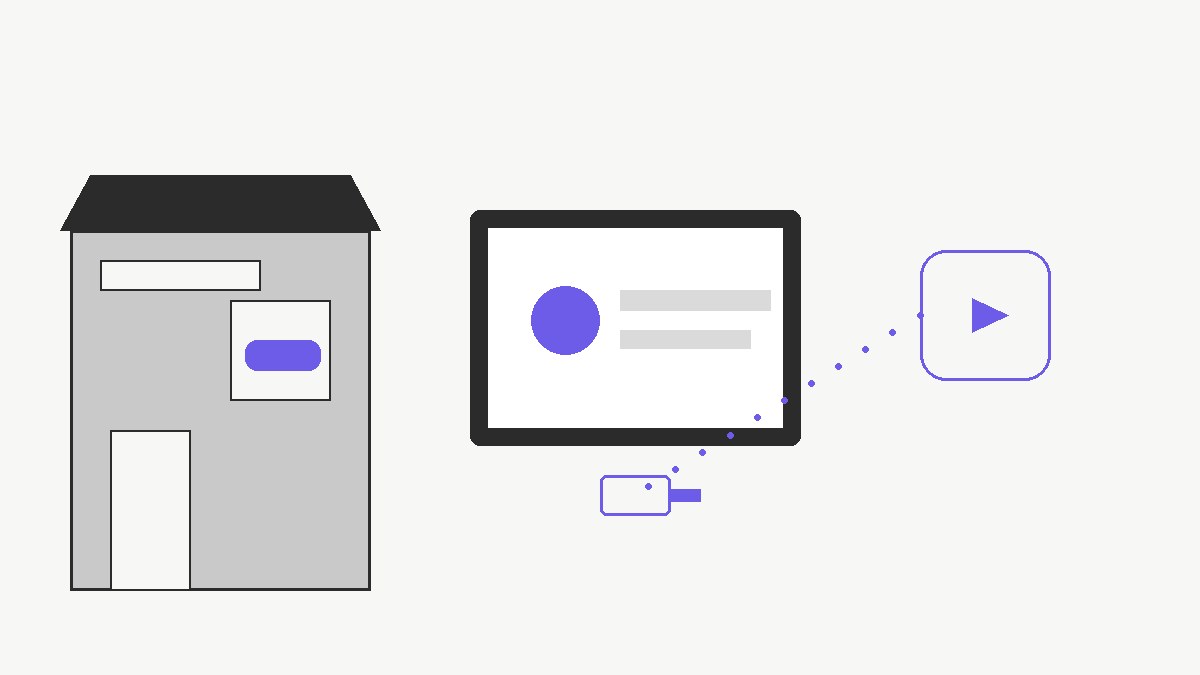
For a nail salon, a corner cafe, or a one-chair barbershop, "digital signage" used to mean calling an AV integrator, buying a dedicated media player, and signing a service contract. That barrier is collapsing. Today a business owner can buy a generic Android TV dongle in the $20–$50 range, plug it into any HDMI port, and install a signage player app from the Google Play Store . PosterBooking describes the path plainly: "plug the Stick into the TV, and download the app and upload content via the PosterBooking dashboard" . PiSignage's 2025 guide tells small businesses to "transform your Android Smart TV into professional digital signage… no extra hardware required — use your existing Android TV" .
The economics are the draw. OptiSigns' own download page confirms the install channel: "Compatible with all Android devices including Android TV and Chromecast with Google TV. Download and install the OptiSigns app from the Google Play Store" . ScreenCloud's platform is "Android and powered by ScreenCloud," with ScreenCloud OS running on supported Android hardware . For the microbusiness owner, the pitch is real: one cheap stick, no set-top box, no technician.
Why vendors say Android "won" the category
The ecosystem itself is the clearest evidence that this is a trend, not a fad. At least six established SaaS vendors — OptiSigns, Yodeck, ScreenCloud, Kitcast, PosterBooking, and Rise Vision — ship Android or Android-TV player apps . In January 2026 OptiSigns stated outright that "Android powers a large portion of digital signage deployments running today" and explained "why Android won this category: hardware variety… lower cost floor… fleet management APIs" . PiSignage, Kitcast, and ScreenCloud all confirm Android adoption in current (2025–2026) guidance .
Critically, Android TV is not a fringe OS. Wikipedia's Android TV entry notes the platform is middleware for more than 30 OEMs and operators — Sony, Panasonic, Philips, Sharp, TCL, Hisense, Xiaomi, NVIDIA Shield, TiVo Stream 4K and others — and had passed 10,000 compatible Play Store apps by May 2022 . Microsoft's Device Ecosystem Platform (MDEP) is pushing an Android-based standard for signage hardware . For the microbusiness owner, that breadth means the screen they might already own — a Sony Bravia, a TCL, a Chromecast-class dongle — is already signage-capable.
The subscription trap hiding behind "free"
Here the neutral framing matters. The "free" hook is the industry's front door: PosterBooking offers "first 10 screens free" ; Yodeck and Rise Vision advertise free tiers ; OptiSigns has a $0 plan . But free is a recurring-revenue on-ramp. Paid per-screen plans run roughly $7 to $45 per month: OptiSigns Standard is $10/screen/month, Pro Plus $15, Engage $30, Enterprise $45 ; Kitcast Starter is $9 ($7 annual) ; NoviSign is $14 ; ScreenCloud Core is $20 and Pro $30 per screen/month ; Yodeck Plus is $8 .
The total cost of ownership tells the story. Five screens at OptiSigns Standard ($10/month) is about $600/year — roughly $1,800 over three years . By contrast, a dedicated BrightSign HD226 player runs about $560 one-time, plus BSN.cloud subscriptions from $139/year, or about $1,037 over three years including the annual subscription . The shapes are different: Android signage spreads cost into a permanent monthly bill; dedicated hardware front-loads it. Vendors document the SaaS band; they rarely frame it as a trap .
Android vs. dedicated players: what you trade
BrightSign, the commercial-player benchmark, sells entry media players from $150 and LS/XD/XT series units from $360 to $960 . Its pitch is reliability as a product category: "playback with self-healing & remote management for unmatched uptimes," local content storage, and "secure built-in remote player management" . Those are claims aimed squarely at the weakness of consumer Android hardware, which lacks industrial thermal design and watchdog reset circuits.
Android-stick vendors counter with their own 24/7 claims — OptiSigns markets its curated OptiStick ($99.99) for "reliable 24/7 performance" ; Kitcast lists offline playback, SSO/SAML, MDM control, and audit logs . But a generic $50 dongle is a consumer device not engineered for continuous duty. The gap between marketing and hardware reality is real : a salon's playlist may survive a year, or a summer heatwave may reboot it at noon. The honest read is that Android signage wins on cost and ease, while dedicated players win on engineered uptime — and the buyer is trading one for the other.
Security: the BADBOX botnet and the uncertified-stick trap
The "secure" claim deserves harder scrutiny than vendors give it, because there is now documented, independent evidence of a large-scale threat aimed squarely at the cheapest Android hardware. In June 2025 the U.S. FBI's Internet Crime Complaint Center (IC3) issued a public warning about the BADBOX 2.0 botnet — a network of millions of compromised Internet-of-Things devices, including TV streaming boxes, digital projectors and smart TVs, that criminals had often infected with backdoor malware before the device was even purchased, or during first-time setup . The FBI's own warning signs read like a spec sheet for the bargain dongle: "Android devices that are not Play Protect certified," "IoT devices advertised from unrecognizable brands," and "generic TV streaming devices advertised as unlocked."
That is not hypothetical. Malwarebytes, reporting on the disruption campaign led by Germany's BSI, estimated BADBOX had reached roughly one million affected Android devices — streaming boxes, tablets and smart TVs among them — and quoted Satori Threat Intelligence on exactly which hardware was hit: "lower-price-point, 'off brand', uncertified" Android Open Source Project devices, explicitly "not Android TV OS devices or Play Protect certified Android devices" . In other words, the risk is concentrated in no-name, uncertified sticks bought for the lowest possible price — precisely the "$20 generic stick" this article names as the entry point — and not in mainstream, Play-Protect-certified Android TV units from Sony, TCL, NVIDIA Shield or Chromecast-with-Google-TV . The Register, whose reporting helped unmask the operation, noted in mid-2025 that a "Version 3" wave should be expected, and security firms continued to track BADBOX activity into 2026 .
The practical read for a small-business owner is not "avoid Android" but "buy certified, and isolate it." A Play-Protect-certified device (Chromecast with Google TV, NVIDIA Shield, or a vendor's own certified stick such as OptiSigns' OptiStick) is a different risk class from an unbranded $20 dongle, and Google Play Protect blocks known BADBOX-linked behavior at install time on certified hardware . Put the signage player on a separate guest Wi-Fi network, away from the point-of-sale and other business systems, so that even a compromised box cannot reach sensitive traffic. This does not undo the core finding — Android signage is real and cheap — but it moves the security caveat from a vendor-asserted footnote to a documented, buyer-actionable risk.
Where the microbusiness actually shows up
The vertical fit is now sourced, not assumed. ScreenCloud's 2024 guide names "nail bars," "nail studios," barber shops, and spas as beauty-signage users on its Android-based platform . Kitcast lists Android TV among supported salon and spa signage platforms . Industry reporting has long flagged hair and nail salons as an attractive signage vertical — "what strip mall have you seen that doesn't have one?" — with a 50-screen New Jersey salon deployment as a real example . Programmatic DOOH inventory includes "more than 7,600 digital screens in gyms, salons and barber shops across Brazil" . For the cafe, gym, and salon owner, the use case is demonstrably mainstream.
Two gaps remain, and they should be stated plainly. First, no fetched source quantifies Android TV's percentage share of the digital-signage OS market . Market-size figures — Precedence Research puts the global market at $29.19 billion in 2025, heading to $57.72 billion by 2035 — describe the whole category, not Android specifically. Every market-report domain with an OS-share breakdown was unreachable during research (Cloudflare or timeout blocks). The "Android won this category" line is a vendor assertion, not a measured figure . The adoption direction is strongly evidenced; the precise number is not.
Second, a single named nail-salon customer running Android TV signage could not be retrieved. Current evidence ties nail/beauty salons to Android-capable platforms , and a dated 2014 Android-box salon deployment exists , but the one vendor case study discovered (NoviSign's "Lords & Ladies Salon") was Cloudflare-blocked and unreachable . The vertical and platform fit is closed; the named-deployment case study is open.
Android-based signage is no longer experimental for microbusinesses: a $50 stick, a Play Store app, and a free first screen put a working display within an afternoon's effort of any salon or cafe. The trajectory — major OEMs standardizing on Android TV, Microsoft's MDEP, and six vendors shipping Android apps — points to broader, not narrower, adoption through 2026. The open questions are not whether it works, but at what recurring cost and with what unmeasured reliability the cheapest hardware will hold up under a shop window's heat. Those are the numbers a buyer should weigh before the stick goes in the HDMI port — and the security evidence argues for weighing them on a certified, Play-Protect device placed on its own guest network, not on the lowest-price dongle a marketplace will ship.